Worried your DVD collection will wear out on the shelf? Here is how to store DVDs: keep them in their cases, upright, in a cool, dry, dark spot with steady temperature and humidity, and handle them by the edges.
This guide sits inside the wider topic of film collecting for beginners, so start there if you are building a shelf from scratch.
| Item | Value |
|---|---|
| Target storage temperature | About 20°C (68°F) |
| Target relative humidity | Around 40% |
| Home range suggested by a public library | Around 70°F with 35% to 45% humidity |
| Gap between discs and the floor | At least 3 inches |
| Manufacturers’ lifespan claims for optical discs | Up to 100 years (hard to verify) |
These figures come from the Digital Preservation Management tutorial and the Austin Public Library disc care sheet. Guidance can change, so check the sources before you rely on the numbers.
What temperature and humidity suit a disc shelf?
The most useful rule is stability. The Digital Preservation Management tutorial advises a consistent temperature of about 20°C (68°F) and relative humidity around 40%, with no large or rapid swings.
For a home shelf, the Austin Public Library suggests preferably around 70°F and 35% to 45% humidity. It adds that the key factor at home is a place that does not fluctuate in temperature.
Archive-style guidance is a little cooler. A NIST-derived quick reference lists less than 20°C and greater than 4°C, with relative humidity from 20% to 50%, and calls 18°C and 40% RH suitable for long-term storage.
Spots to avoid, according to the library sheet:
- Near windows, heaters, or on top of equipment such as TVs and VCRs.
- Inside a sun-warmed car.
- Under or near water pipes, water heaters and sinks.
- Anywhere that gets prolonged sunlight or other ultraviolet light.
If a disc has been somewhere very different, let it acclimate before playing. The tutorial advises letting media adjust to new temperature and humidity before use, then returning it to controlled storage straight after.
Shelving: upright, in cases and off the floor
Store discs vertically, like books. The library sheet says never to keep them flat, because that can cause warping that prevents playback, and the tutorial says to shelve media vertically rather than stacked.
A NIST-derived quick reference also says not to store discs horizontally for a long time, meaning years. If a pile of flat cases is your current system, this is the first thing to change.
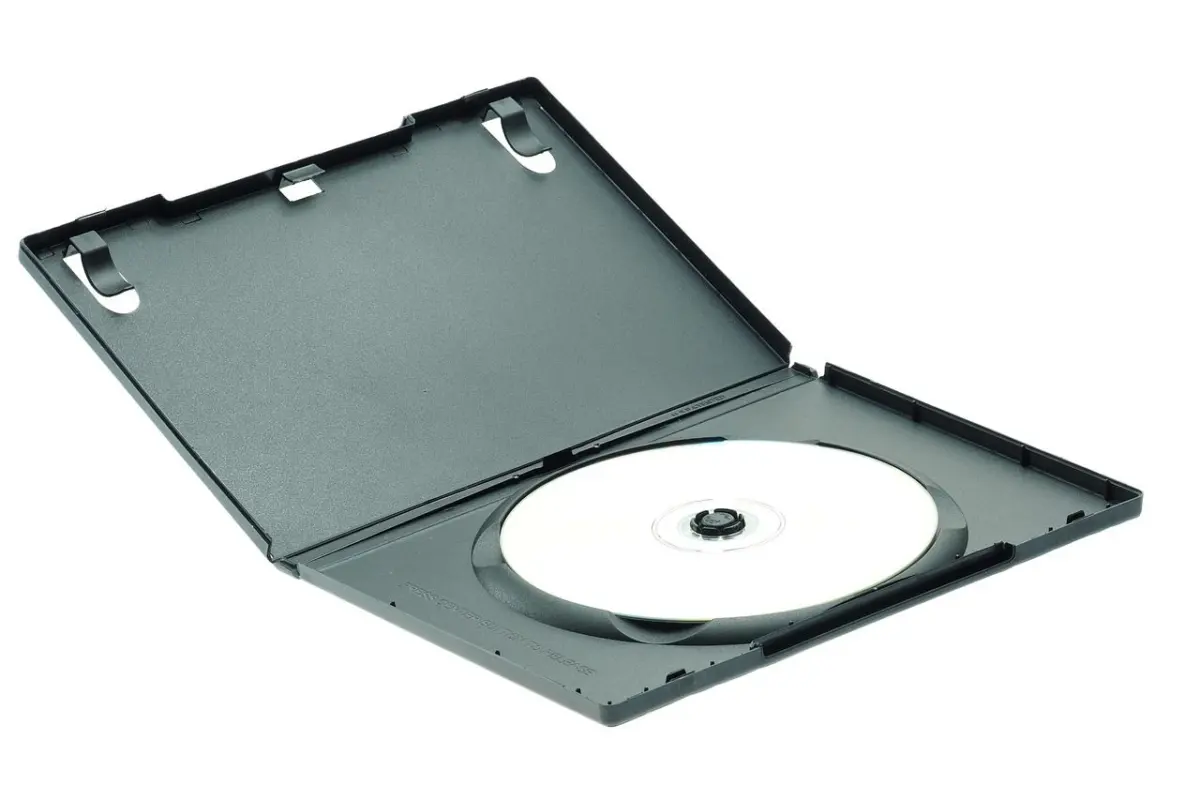
Keep each disc in its case. The tutorial recommends original cases, and the library sheet says cases protect against dust, moisture and other environmental problems.
Keep the lowest shelf clear of the floor too: the library sheet recommends a minimum of 3 inches off the floor, which gives some protection from spills and leaks.
Handling, labelling and cleaning
Most damage happens in the hand. A quick reference guide built from NIST advice gives a short routine:
- Hold the disc by the outer edge or the centre hole.
- Never touch the surface or bend the disc.
- Put the disc back in its case straight after use.
- Keep dirt and foreign matter off it.
The Austin sheet warns that fingerprints may be acidic enough to damage a disc. Flexing a disc when you pull it from the case strains the glue holding its layers together, so press the hub release and lift gently.
Labels and markers
Do not stick adhesive labels on discs, because they can warp or unbalance them. If you must mark a disc, use a felt-tip permanent marker on the label side, and never a pen, pencil or fine-tip marker.
Cleaning
Wipe with clean cotton fabric in a straight line from the centre to the outer edge, never in a circle, because circular scratches can follow the tracks and make a disc unreadable. For stubborn dirt, both sources name CD/DVD cleaning detergent or isopropyl alcohol.
Disc rot, glue failure and recordable discs
Pressed discs can still fail with age. The Austin sheet describes disc rot, where the surface gradually breaks down and the data can no longer be read, and says proper storage and handling can reduce the chances, though it is not clear how to prevent it.
It also notes that the glue holding a DVD’s layers together can lose its grip, especially in early DVDs, leaving the disc unreadable at least in parts. According to the NEDCC textbook, DVDs were introduced in 1995, so early copies have had plenty of time to age.
Home-burned discs need extra care:
- Rewriteable discs should not be used for long-term storage, because their heat-sensitive layer decays much faster than the metal layers of other discs.
- For archiving recordable discs, the NIST-derived guide recommends a gold metal reflective layer.
- Do not write in the data area, and open a recordable disc package only when you are ready to record.
Can you trust lifespan claims when you store DVDs?
Treat them with caution. The Austin Public Library sheet says the actual lifespan of optical discs is unknown, and that manufacturers frequently cite up to 100 years but without standardized tests those claims are hard to evaluate.
The Digital Preservation Management tutorial goes further: life expectancy claims are statistical averages from accelerated aging tests, and longevity gives no protection against theft, disasters or handling damage. It also says all media needs to be backed up.
For rare or home-recorded discs, that means making a copy rather than trusting the shelf. Austin’s guidance adds that older discs may need copying to a newer format as technology moves on.
If you are weighing formats, the dvd vs blu-ray differences are worth reading before you decide what to keep. And if a well-kept disc refuses to play, what is a dvd region code explains a cause unrelated to damage.
Frequently asked questions
Can I stack DVDs flat to save space?
Show answer
It is best not to. The tutorial says to shelve media vertically rather than stacked, and the library sheet says flat storage can cause warping that stops a disc playing.
Is a basement or attic a good place for discs?
Show answer
Probably not. The sources warn against hot areas, large temperature and humidity swings, and spots near water pipes, so choose a stable indoor room instead.
Should I throw away cases and use sleeves?
Show answer
The sources recommend keeping discs in their original cases, upright, and returning them there straight after use.
Can I write on a disc to label it?
Show answer
Only on the label side, with a felt-tip permanent marker. Avoid pens, pencils, fine-tip markers and adhesive labels.