Wondering which basic embroidery stitches you should learn first? Start with running stitch and backstitch for lines, then add chain, satin and French knot for texture and fills. A handful is enough for many beginner patterns.
This guide sits alongside other beginner craft projects for anyone trying a new hobby.
| Item | Value |
|---|---|
| Easiest embroidery stitch | Running stitch |
| Hand embroidery stitches and variations | Nearly 300 |
| Strands in one skein of floss | 6 strands |
| Crewel needle sizes for surface embroidery | Sizes 3 to 9 |
| Typical hoop diameter | 4 to 12 inches (10-30 cm) |
These figures come from Craft Passion’s stitch roundup and Practical Embroidery’s beginner guide. They can change, so check the source before you rely on them.
What you need for basic embroidery stitches
Embroidery asks for very little kit. Cotton, linen or a blend is a sensible fabric, because Practical Embroidery’s beginner guide notes that beginners often start with these and find them easy to work with.
A hoop keeps the fabric taut while you stitch, and hoops typically measure 4 to 12 inches (10-30 cm) across. For a first project, Practical Embroidery’s free beginner e-book calls a 6-8 inches (15-20 cm) hoop an excellent size.
Floss and needles come next. Each skein separates into six strands, so you can choose how thick your stitches look, and crewel needles labelled sizes 3 to 9 suit surface embroidery, as the same guide explains.
Your starter list is short:
- A piece of cotton or linen fabric, washed and ironed so it is clean and crisp
- An embroidery hoop
- Embroidery needles
- Embroidery floss in colours you like
- A small, sharp pair of embroidery scissors
- A water-soluble pen, friction pen or pencil to mark your lines
Line stitches: running, back, stem and split
Line stitches draw outlines, lettering and stems. Learn these four first and you can already outline almost any simple design.
Running stitch
Running stitch is the simplest embroidery stitch to learn, and it is versatile for embroidery and other embellishments, according to LoveCrafts’ top stitches guide. Come up from the back, go down a short distance away, then repeat. Keep each stitch the same length for the neatest result.
Backstitch
With backstitch, each stitch is worked backwards from the direction the line travels. The individual stitches touch end to end and form a continuous line. It suits outlines and is also great for lettering on fabric.
Stem stitch
Stem stitch makes a rope-like line, which is why it works so well for curves and plant stems. Keep your working thread below the line of stitching as you go. If you dislike the slightly angled look, you can keep the stitches straight and right on your pattern line.
Split stitch
In split stitch, each new stitch splits and comes up through the previous one. The result is a solid line that barely shows each individual stitch. For a smooth line without a gap, let the needle go through a strand or two of the thread rather than between the strands.
Looped stitches: chain, lazy daisy, fly and blanket
Looped stitches hold the thread on the surface of the fabric before locking it down. They give you thick lines, petals, borders and neat edges.
Chain stitch
Chain stitch is a decorative looped stitch that works in a straight or curved line. It makes a thick line, and you can stitch rows and rows of it to fill in an area.
Lazy daisy
The lazy daisy is a single chain loop, sometimes called a detached chain stitch. Use it for flower petals, raindrops and other small details. You can make the loops tiny, or long and skinny.
Fly stitch
Fly stitch is a Y-shaped stitch. Scatter it to fill an area, or work it in lines for a border. Changing the length of the bottom stem, or the tension of the thread, turns the Y into a V or a U.
Blanket stitch
Blanket stitch is worked along the edge of fabric to finish it in a decorative way. The Lia Griffith stitch guide calls it a simple stitch that is easy to learn and a great starting point for teaching little ones to sew. It also attaches appliqués neatly.
Texture and fills: French knot and satin stitch
French knot
The French knot has a reputation for being difficult, but with practice and the right tension it becomes manageable. Per LoveCrafts, you wrap the thread around the needle two times, then insert the needle next to the point where the thread came up, not into the same hole.
Hold the working thread taut as you pull the needle through. Knots are almost impossible to unpick, so start with a fresh length of thread when you can. That makes it easier to cut a knot away and redo it.
Satin stitch
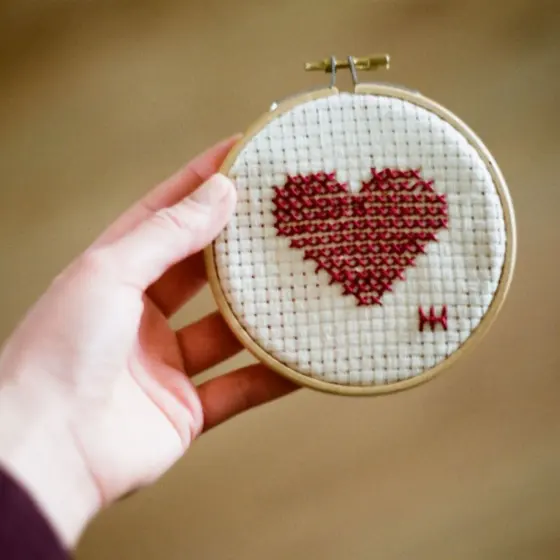
Satin stitch is a series of straight stitches that fills a shape with a smooth, satin-like surface. It works for any shape, big or small, and is a good alternative to cutting out and sewing on tiny appliqué details. You can add a backstitch outline around it for a crisp edge.
For an irregular shape, start at the centre, fill one side, then move to the second half, as Practical Embroidery advises.
How should you practise these stitches?
The best way to learn stitches is by making them. A simple sampler gives you somewhere to practise every stitch on one piece of fabric.
- Draw straight and curved lines for running stitch, backstitch and chain stitch.
- Add a few simple shapes to fill with satin stitch.
- Scatter small dots for French knots in the gaps.
- Work each stitch in turn, and repeat any that feel uneven.
Watch your tension. Avoid pulling the thread too tight, because it can make the fabric pucker, and work in good light so you can see the details. Everyone stitches wonky lines at first, so keep going.
Between stitching sessions, you might enjoy a needle-free hobby, and a guide on how to do decoupage is a good place to start.
As your floss and needles multiply, it helps to know how to organize craft supplies so everything stays tangle-free.
Frequently asked questions
How many embroidery stitches do I need to learn?
Show answer
There is no set minimum. Craft Passion counts nearly 300 hand embroidery stitches and variations, and a handful of them covers a wide range of beginner patterns.
Which embroidery stitch is the easiest?
Show answer
Running stitch is the easiest, according to Craft Passion’s stitch roundup. Backstitch comes second.
Is the French knot really that hard?
Show answer
It has a reputation for being difficult, but practice and the right tension make it much easier. Work it with a fresh length of thread so you can cut a knot away and try again.
What is the difference between chain stitch and lazy daisy?
Show answer
A chain stitch links loops into a line, while a lazy daisy is one loop held down at its tip. It is sometimes called a detached chain stitch.