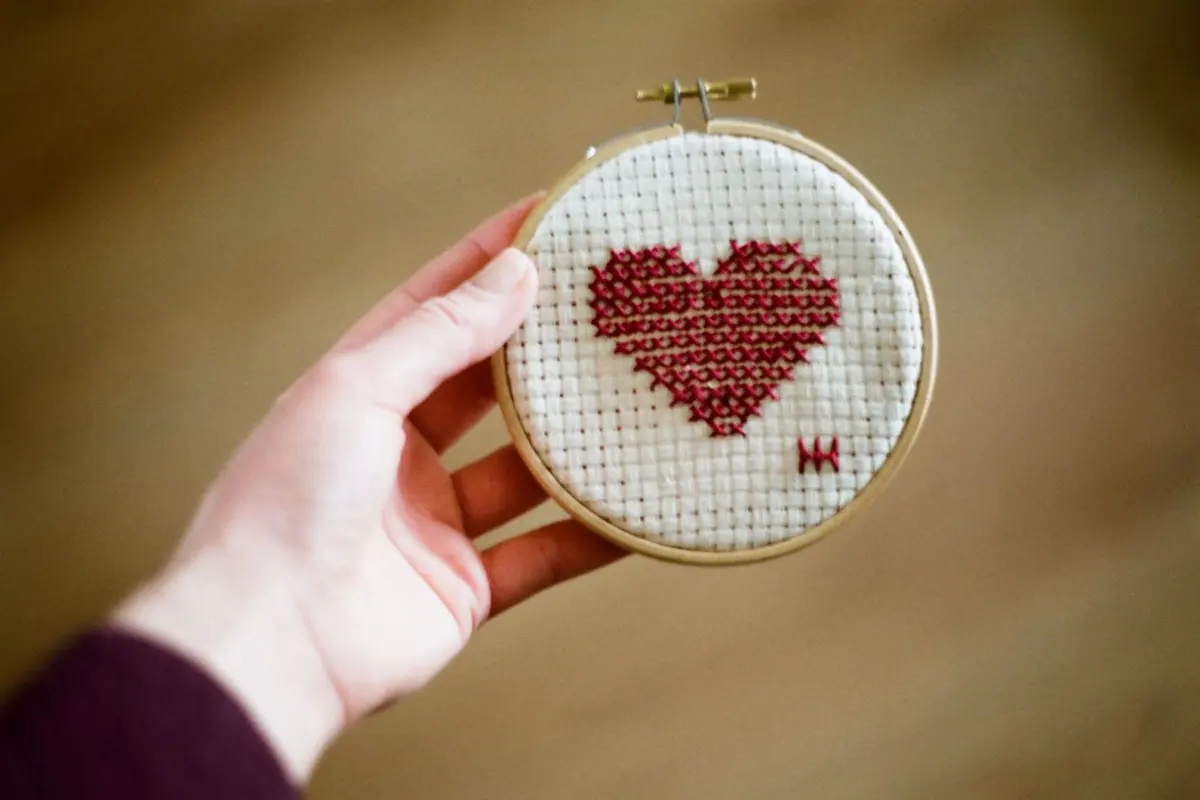
Not sure how to start cross stitch? You need only Aida fabric, floss, a needle and a chart. Begin with 14-count Aida, two strands of floss and a small design, then stitch your first X.
This guide is part of our collection of beginner craft projects, written for readers weighing up a first needlework project.
| Item | Value |
|---|---|
| Beginner fabric count | 14 squares per inch (14-count Aida) |
| Strands in a floss skein | 6 strands |
| Strands per stitch on 14-count Aida | 2 strands |
| Needle size for 14-count Aida | Size 26 (one supplier’s chart) |
| Aida squares per cross stitch | 1 square |
These figures come from The Art of Stitch’s beginner guide and Gathered’s beginner guide. Suppliers differ on details such as needle size, and guidance can change, so check the sources before you rely on them.
What you need to start cross stitch
Cross stitch is a gentle entry point. The Embroiderers’ Guild of America points out that there is only one stitch to learn, the X, and that supplies are inexpensive and easy to find.
A supplier’s beginner guide lists these essentials:
- A cross stitch chart
- Embroidery thread, also called floss
- Fabric, either Aida or evenweave
- A needle
The same guide treats an embroidery hoop, fabric glue, a needle minder and a magnifier or task lighting as optional. A retailer’s how-to guide adds that a pair of small, sharp scissors is also worth having.
If you would rather not pick every item yourself, buy a kit. The same retailer says beginners will probably start with a kit that includes everything they need, so fabric choices can wait.
Choosing fabric, thread and needle
Fabric and fabric count
Beginners usually start on Aida, a block-weave fabric divided into squares by a grid of holes. Gathered’s guide notes that each cross stitch is worked over one square.
Fabric count is the number of squares per inch. The Art of Stitch describes 14-count as 14 squares per inch, the most popular choice for beginners, with a good balance between ease and detail.
A lower count such as 11 squares per inch gives larger holes that are easier to see, and a larger finished design. An 18-count fabric has smaller holes and a more detailed look. The same guide suggests starting with 14-count Aida and moving to 18-count once you are comfortable.
Floss and strands
Floss is usually six-stranded, and Gathered says you separate out two or three lengths for a project. On 14-count Aida you usually use two strands.
According to the retailer guide, the higher the fabric count, the fewer strands you generally use. Too many strands make it hard to force the needle through the holes, while too few may leave a faded, patchy look.
Needle
Use a blunt-tipped tapestry needle with a large eye, as Gathered describes. Size charts differ: one supplier pairs size 26 with 14-count Aida, while a retailer says sizes 22 and 24 suit most counts of Aida and evenweave.
If you are stitching a kit, use the needle that came with it.
How do you read a cross stitch chart?
A chart is a grid of coloured squares containing symbols. According to Gathered, these show which squares to stitch on the fabric and in what colour.
- Use the legend to match each symbol to a floss colour, as Stitched Modern advises.
- Look for the arrows on the edge of each side, which mark the centre of most charts.
- A tiny symbol in the corner of a square marks a fractional stitch.
- Darker grid lines mark every block of ten stitches, which makes counting easier, according to Adafruit’s guide.
- If the design has backstitching for outlines or fine detail, there may be a separate chart page showing only that stitching.
You may also wish to mark finished rows on the pattern in pencil, a tip from Adafruit.
Prepare your fabric and hoop
A few minutes of preparation saves frustration later. Work through these steps before the first stitch:
- Iron out creases. The retailer guide says crease-free fabric helps stitches lie flat and look uniform.
- Secure raw edges with masking tape or a zigzag stitch to prevent fraying, as Adafruit suggests.
- Find the centre. Fold the fabric in half horizontally and then vertically; the point where the creases cross marks the centre, according to Gathered.
- Mount it in a hoop if you want one. Adafruit recommends a 6-inch hoop for most projects, with the fabric taut and square.
Do not pull the fabric too tight, because that can distort the weave. Stitching in hand, without a hoop, is probably more appropriate for an experienced stitcher, because uneven tension can distort your stitches.
Stitch your first pattern step by step
Choose a small design with large blocks of one colour. Stitched Modern says a large block of colour is easier to start with than an area that changes colour often.
Gathered offers a free chevron pattern for beginners in which you can use any colours you like and rarely need to rethread your needle. Begin near the centre of the chart, and of your fabric.
- Cut your floss. One retailer suggests 40-50cm, while another guide suggests about 18 inches and warns that longer thread is more likely to knot.
- Separate the strands. Pull the strands out individually, because pulling several together may cause the floss to knot, Stitched Modern warns. Then recombine the number of strands your chart calls for.
- Thread the needle without a knot. You stitch over the tail to secure it, which avoids lumps in the finished piece.
- Come up from the back at your starting hole, leaving about an inch of thread at the back.
- Make the first half of the X. Gathered describes a diagonal stitch from bottom left to top right over a single Aida block, then a second diagonal from bottom right to top left, crossing the first.
- Work a row. Adafruit says you can complete each X before starting the next, or stitch a row of bottom stitches and then return along it to add the top stitches. Keep the top diagonal in the same direction every time for a consistent look.
- Finish the thread. When about 5 inches of floss are left, slide the needle under a few stitches at the back and clip the end, as Adafruit describes.
- Check your work. When you finish, look over the whole project for uncrossed stitches.
If you prefer a knot, the waste knot method works too. Gathered explains that you take the needle down through the Aida a short distance from your start, bring it up where the first stitch begins, and leave the knot on the surface to snip off once the thread is secure.
Habits that keep your work tidy
- Untwist tangles. If the floss is tangling or too twisty, let the needle hang freely so the floss can untwist, Adafruit advises.
- Keep hands clean. Your skin’s natural oils may mark the fabric, especially where it bends over the rim of the hoop.
- Keep the back tidy. Try not to carry thread across blank spaces at the back, especially with dark colours, because it may show through.
- Pull floss from the right end. The Embroiderers’ Guild of America advises pulling floss from skeins at the long label end.
Once your first piece is finished, you could try how to make beaded jewelry or how to knit for beginners as another small starter craft.
Frequently asked questions
Do I need a hoop to start cross stitch?
Show answer
No. The Art of Stitch lists a hoop as an optional tool. A hoop does help keep tension even, which the retailer guide says matters because uneven tension can distort stitches.
Should I choose Aida or evenweave?
Show answer
Choose Aida first. Gathered describes evenweave as a grid in a finer count, where each stitch is usually worked over two threads, and says most patterns treat 28-count evenweave as the equivalent of 14-count Aida.
Where should I start stitching on the fabric?
Show answer
Start at the centre. Gathered says starting at the point where the creases cross helps keep the design in the middle of the fabric.
Why does my floss keep tangling?
Show answer
Thread that is too long is more likely to knot, and Stitched Modern suggests about 18 inches. Pull strands apart one at a time, and let the needle hang freely to untwist the floss.