Wondering how to grade book condition before you buy, sell or shelve a copy? Judge the binding, pages and jacket against a standard scale from As New down to Poor, and note every flaw. Most collectors want Very Good or better.
If you are just starting out, our guide to book collecting for beginners puts grading in the wider picture.
| Item | Value |
|---|---|
| Highest grade for a collectible book | Fine (F) |
| Usual minimum grade for collectors | Very Good (VG) or better |
| Rough numeric scale for Fine / Very Good / Good | 10 / 8 / 6 on a 1-to-10 scale |
| Year the standard trade grade list was first proposed | 1949 |
| Book and dust jacket | Graded separately, for example Fn/VG+ |
These figures come from the Stratemeyer Syndicate’s condition definitions and Biblio’s guide to book conditions. Grading terms vary by seller and region, so check the sources before you rely on them.
The grading scale from As New to Poor
Most sellers use the same ladder of grades, but the exact criteria can differ. AbeBooks says its guide is a general reference because criteria may vary by seller and region, and it defines As New as pristine, original condition as when published.
Working down from the top, the usual grades read like this:
- Fine (F): nearly As New, but without being crisp.
- Near Fine (NF): approaching Fine, with a couple of very minor defects the seller must note.
- Very Good (VG): small signs of wear, but no tears on binding or paper.
- Good (G): average wear, with the complete text pages still present.
- Fair: worn, with complete text pages, but it may lack endpapers or a half-title.
- Poor (reading copy): heavily worn, and its main value is a complete, legible text.
The trade’s shared vocabulary goes back a long way. The Stratemeyer Syndicate notes that the Antiquarian Bookman Weekly list was first proposed in 1949 and remains a standard, that the highest grade is Fine, and that sellers add + or – to show a copy sits a little above or below a grade.
Collectors tend to be strict. Biblio says a book in very good condition is often cited as the minimum for most collectors, and it repeats the saying “good isn’t good”, while adding that a Good copy usually suffices as a reading copy.
How do you check a copy step by step?
Work through the book in the same order every time, so you never skip a flaw. A calm, well-lit table helps, and so does handling the book gently.
- Completeness: confirm that every text page, plate and map is present. A missing map or plate has to be noted at any grade.
- Binding: open the book carefully and check the hinges. A shaken book has pages beginning to come loose from the binding, according to AbeBooks.
- Covers and spine: look for edge wear, shelf wear, bowed boards and chipping.
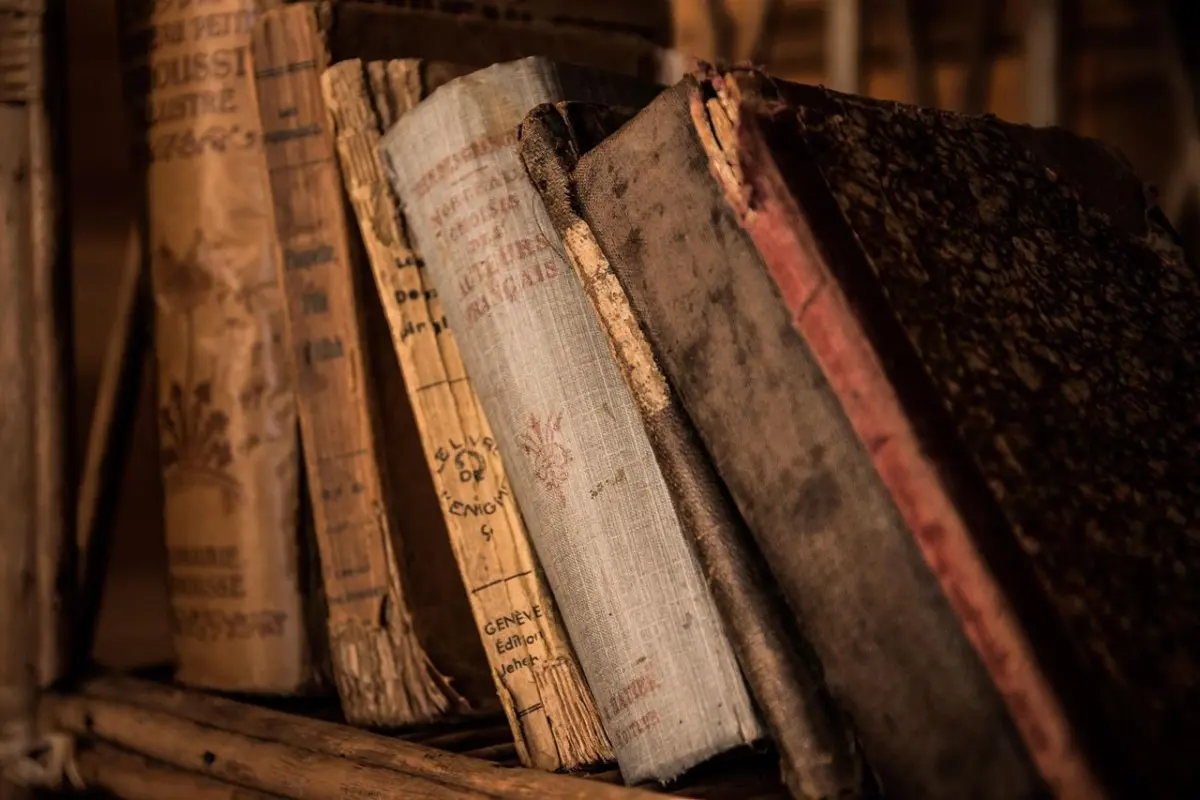
- Light damage: a sunned book has faded from exposure to light or direct sunlight.
- Pages: scan for foxing (brown spotting caused by a chemical reaction), stains, underlining and writing.
- Ownership marks: check for library stamps, bookplates, inscriptions and book club signs.
- Jacket: grade the dust jacket on its own, then write the grade with every flaw named.
Defects carry different weight. Town’s End Books ranks water damage, binding breaks, underlining in text, large tears, missing pages, ex-library copies and mould as very major defects, while fading of the cloth, a scuffed jacket, light soiling and minor chipping count as minor ones.

Dust jackets, ex-library copies and other flags
The book and its jacket are graded separately, the Stratemeyer Syndicate explains, so Fn/VG+ means a Fine book in a VG+ jacket. It is common for a jacket to have more wear than the book.
If a book was issued with a jacket, the State Library of Pennsylvania’s research guide says the lack of one should be noted. It also advises you to save a jacket even if it is torn, because it still enhances the book’s value.
Some flags apply whatever the grade:
- Ex-library: the same State Library guide says these copies must always be designated as such, no matter what the condition of the book. Biblio adds that they sell for less because of pockets, stamps and catalogue numbers.
- Book club: editions must always be noted as such, according to the State Library guide.
- Price clipped: a jacket with the price cut from the corner, which AbeBooks says usually reduces the value.
- Remainder: a marked overstock copy, which AbeBooks says can still be As New and good value for money.
Age is not a flag. The Stratemeyer Syndicate states that the age of a book is never a reason to change its condition, so “good for its age” is not a grade.
Why does condition change a book’s value?
Condition and price move together. The Stratemeyer Syndicate gives a rough illustration: if a Fine “10” copy is worth $100, a Very Good “8” might be $50, and a Good “6” might be very hard to sell even at $25.
Those numbers are an example, not a price guide. The Horatio Alger Society suggests weighing rarity too: could you find the same book in better condition relatively easily?
It also points out that repairability matters. A cracked hinge is fairly easy to fix if you have the skill, but a cover scribbled on with permanent marker is much harder.
Grading honestly and keeping the grade
Every collector, seller and buyer judges condition a little differently, the Horatio Alger Society says. Its advice when you are stuck between two grades is to choose the lower one, which lowers the chance of misrepresenting the book.
If you are selling, do not just write “Condition is Fair”. List the damage and provide sufficient photographs, as the same society recommends.
Record each grade next to the title when you learn how to catalog a home library, so your notes stay consistent. Grades can slip if a book sits in light or damp, so read up on how to store books properly once you know what you own.
Frequently asked questions
What is the difference between Fine and Near Fine?
Show answer
A Fine book is nearly As New but without being crisp, and it shows no defects. Near Fine has a couple of very minor defects, which the seller must note, according to AbeBooks.
Is a book in Good condition worth collecting?
Show answer
Usually not. Biblio says Good is generally not accepted for collectors except for very scarce material, though it usually suffices as a reading copy.
Do I grade the dust jacket separately?
Show answer
Yes. The Stratemeyer Syndicate says the book and jacket are graded separately, and a pair is written like Fn/VG+.
Is there a grade above Fine?
Show answer
Not for used collectible books. The Stratemeyer Syndicate says there is no “Mint” or “Very Fine” in book grading, since those terms belong to coins and comic books.